

Professor Jun-seop Kim of INU Publishes Research Paper in Signal Transduction and Targeted Therapy, One of the World’s Leading Academic Journals… Industry-Academia Collaboration Expected in Connection with Incheon's Bio Industry Strategy
- NO
- 429626
- Date
- 2026-08-31
- modification day
- 2026-08-31
- Writer
- 홍보과 (032-835-9490)
- Count
- 329

Professor Jun-seop Kim of Incheon National University
Incheon National University (INU), led by President Injae Lee, announced that Professor Jun-seop Kim of the Division of Biotechnology (Nano-Bioengineering) has published a research paper in Signal Transduction and Targeted Therapy, a leading international journal in the fields of biochemistry, molecular biology, and cell biology.
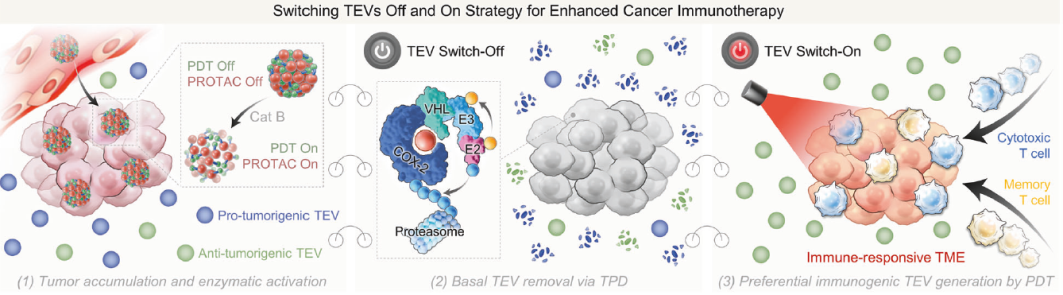
Tumor-derived extracellular vesicles (TEVs) secreted by cancer cells are known to play an important role in tumor growth and immune evasion. Previous therapeutic approaches have mainly focused on reducing or removing these TEVs. However, recent studies have shown that TEVs can also act as “immunogenic TEVs” and stimulate antitumor immune responses under certain conditions, creating a need for more precise methods of controlling their functions.
In this study, Professor Kim’s research team worked with research teams led by Dr. Mankyu Shim at the Korea Institute of Science and Technology (KIST) and Professor Yoosoo Yang at Sungkyunkwan University to develop a PROTAC-based nanostructure called “EVOTAC.” The researchers proposed a new approach that regulates TEVs through “off” and “on” states. EVOTAC responds to Cathepsin B, an enzyme found at high levels in cancer cells, and first degrades the COX-2 protein to reduce TEV production. Local laser irradiation for photodynamic therapy (PDT) then induces immunogenic stress in cancer cells, leading to the production of TEVs that can stimulate immune responses.
The reprogrammed TEVs reduced tumor growth and metastasis while promoting the maturation of dendritic cells (DCs) and the activation of cytotoxic T lymphocytes (CTLs). In a triple-negative breast cancer (TNBC) model, the treatment resulted in complete remission (CR) and also reduced recurrence and lung metastasis.
The TEVs produced through EVOTAC contained increased levels of antitumor miRNAs and reduced levels of tumor-promoting proteins and miRNAs, showing a distinct immunogenic profile. These findings showed that TEVs can be studied not only as targets for reduction but also as materials whose biological functions can be reprogrammed for therapeutic purposes.
This study presents a TEV reprogramming approach combining PROTAC technology with photodynamic therapy (PDT) and suggests its potential for further research related to personalized cancer vaccine platforms.
The findings were published in the international journal Signal Transduction and Targeted Therapy (STTT). The journal has an Impact Factor (IF) of 81.2 and ranks in the top 0.2% of journals according to Journal Citation Reports (JCR).
INU’s Office of Research operates several internal programs to support research activities, including INU SURE LAB (SUstainable Human REsource Management Program for Research LAB), internal research funding, and financial support for faculty academic activities. Through these programs, INU continues to support research activities and the development of high-quality research outcomes, including Professor Kim’s latest study.
This research is also related to the B (Bio) field of Incheon Metropolitan City’s ABC+EF strategy. Based on the findings, INU plans to continue research activities with relevant institutions and companies in the Songdo Bio Cluster. The university will also examine opportunities for joint research related to next-generation cancer therapeutics and bio-healthcare applications, while continuing to expand research activities in the bio field.
Research Materials
- attached file
- There are no attachments.